Slate Roof Installation Raleigh, NC
- Home
- Slate Roof Installation Raleigh, NC

One Stone at a Time: The Longest-Lived Roof in Raleigh
Drive past the old foursquares on Person Street or the cottages ringing Glenwood Park and you will see roofs laid before your grandparents were born, still shedding Carolina rain one flat stone at a time. Slate is not a roofing material so much as a decision to build for a century, and Raleigh Roof Pro installs and restores it for the Triangle owners who want exactly that. Our slate work concentrates in Raleigh’s historic neighborhoods, with synthetic slate going onto custom homes in Wake Forest, Apex, and Cary where the structure or the budget says natural stone is the wrong call. Every project starts with the two questions slate always asks: can the house carry it, and can the crew lay it. We answer both before a single crate is ordered.
Hard Slate, Soft Slate, and the Synthetic Third Way
Not all slate is the same rock. Hard slate from Vermont quarries keeps its color and its edge for a century and more; soft slate from Pennsylvania and Ohio weathers to gentle tones but delaminates sooner and wants more attention. Synthetic slate, molded from polymers and rubber, copies the shadow and color shift of stone at half the weight and a fraction of the price. We lay samples of each against your house in daylight, explain how each ages in this humidity, and let the structure and the budget cast the deciding votes.
Nail Sickness: Why Old Slate Fails at the Fastener
The stone outlives everything around it, which is why a leaking hundred-year-old slate roof is almost never a stone problem. The original iron nails rust through, the slates slip, and the holes line up in rows that rain finds on schedule. Copper flashing from the same era can fail at the folds. The honest fix is not a patch of sealant; it is re-nailing the slipped slates on new copper or stainless fasteners and rebuilding the metal where it has thinned. We assess the fastener field before we quote, because the difference between a repair and a re-lay lives in the nails, not the slate.
Headlap, Gauge, and Hooks: The Grammar of a Slate Roof
A slate roof holds water by geometry: each stone laps the one below by a set headlap, courses run on a gauge line, and the field sheds because no drop can find a straight path down. Where a nail hole would show or a slate must be replaced mid-field, slate hooks catch the stone from below instead of piercing it. We lay to the quarry’s headlap tables, keep the gauge true with battens or marked lines, and use copper or stainless where metal touches stone. Get any of those three wrong and the roof is just expensive gravel waiting for gravity.
Weight Is the First Conversation
Natural slate runs three to five times the load of an asphalt roof, and no amount of craftsmanship fixes a frame that cannot carry it. Before we price stone, we read the attic: rafter sizing, spans, any sag in the ridge, and the history of the structure, checked against the NC Residential Code where work falls under it. Many of Raleigh’s older homes were built for slate and carry it fine; homes built for lighter materials may need engineering and reinforcement, and some simply should not take stone. When the frame says no, we say no, and show you the synthetic systems that give the look at a load the house already carries.
We Treat Your Slate Like the Artifact It Is
A historic slate roof is original fabric, the same as the heart-pine floors under it, and tearing out good stone to sell a new roof is vandalism with an invoice. Raleigh Roof Pro salvages every reusable slate on a restoration, sorts it on site, and re-lays the sound stone with new fasteners, buying new or salvaged slate only for the field that is truly spent. When your roof is finished, it is still your roof, not a costume, and the patina that took a century to earn stays on the house.
The metal philosophy is just as strict. Copper or stainless only, because a slate roof will outlive every galvanized nail ever driven, and the weak metal becomes the leak long before the stone complains. Flashings, valleys, and drip edges are formed on our brake to the house’s own dimensions, soldered where solder belongs, and detailed to be the last metal the roof needs. If a part of the job has to be cheaper, we cheapen the scope with you, never the metal under the stone.
Salvage, Sort, and Lay: The Order of a Slate Job
We strip only what is spent, catching and sorting every stone as it comes down. Sound slates get cleaned and stacked by size; spent ones get counted against the new or salvage stock we will source. The deck gets checked board by board, underlayment goes down, and the field is laid to gauge with copper nails and hooks, hips and valleys worked in copper or matching slate. The finished roof gets a walked inspection on slate ladders and hooks, never on boots, and you get the count: how much original stone went back, and what was added.
- Sound original slate salvaged, sorted, and re-laid with new copper or stainless fasteners
- Headlap and gauge laid to the quarry's tables, hooks where nails would show
- Copper or stainless flashings, valleys, and drip formed to the house, never stock
- Slate ladders and hooks on every visit, so no boot ever cracks a stone
Slate on Raleigh’s Historic Houses
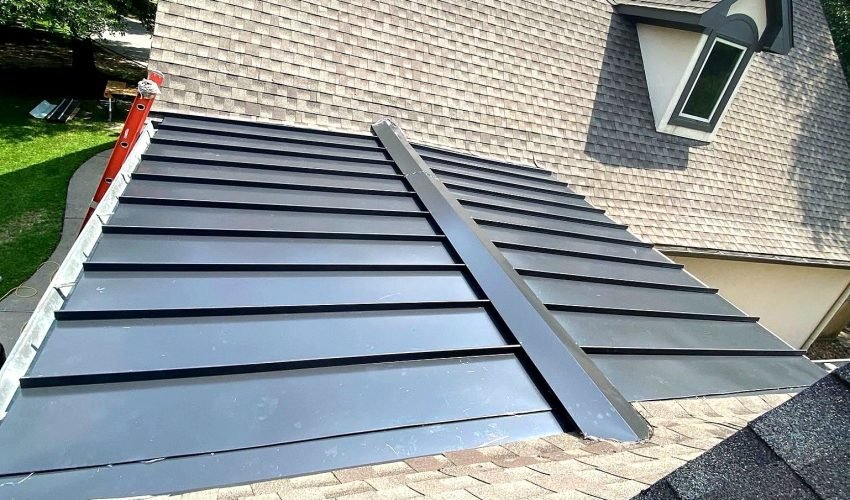
Oakwood, Boylan Heights, Hayes Barton, and Glenwood carry most of the Triangle’s original slate, and work inside historic districts comes with guidelines about visible materials and color. We document the existing pattern before teardown, match replacement slate by quarry region and size when new stone is needed, and source salvaged slate from teardowns when the match matters more than the crate, following City of Raleigh district guidelines where the house sits inside one. The goal is a roof the reviewer approves and the house recognizes, with the original stone doing as much of the work as it can.
The Look of Slate at a Fraction of the Load: Synthetic Options
Composite slate has gotten good enough that the difference reads at arm’s length, not from the street. Polymer and rubber slates carry the staggered color blends and the thick butt edges of stone, shrug off hail that would crack the real thing, and land on a frame that never needs reinforcing. For custom homes in Wake Forest or Apex that want the profile without the century-scale budget, synthetic is the honest recommendation, and we install it with the same flashings discipline we bring to stone. When the whole roof underneath is also at the end, we coordinate the slate work with a full roof replacement scope so you spend once.
What Slate Installation Costs in Raleigh
Slate sits at the top of every roofing price list, and the spread inside it is wide: synthetic runs a fraction of natural, hard slate tops soft, and a full re-lay with salvaged stone sits between. Scaffolding, decking work, copper quantities, and rigging needs all move the number. The structural read and the on-roof assessment that settle those questions cost nothing, and the quote that follows breaks out salvage, new stone, metal, and labor separately, so you can see exactly which decisions carry the price.
Stone Questions: What Slate Owners and Buyers Ask Us
Hard slate in this climate routinely passes a century, and soft slate often reaches seventy-five years or more when the fasteners and flashings are kept ahead of. The stone itself shrugs off our humidity and heat; it is the metal underneath that sets the service intervals. A slate roof is less a purchase than an inheritance, which is why we build the metal to the same standard as the stone.
Almost always the fasteners or the flashings, not the stone. Original iron nails rust through on a schedule, slates slip, and rain enters the old nail holes in tidy rows; valleys and step flashing from the same era thin out at the folds. We locate which rows and which metal are failing, then quote re-nailing and metal work first, because replacing sound stone would spend money the metal never needed.
Yes, and it is routine. A cracked slate is pulled with a slate ripper, its nails cut, and a matching stone slid in and secured with hooks or copper nails so no new hole shows. We keep sources for common sizes and colors, and for historic roofs we pull from salvaged stock so the patch disappears into the field. A dozen swaps now keeps the field tight for decades.
That is the first question we answer, before any pricing. We read rafter sizing, spans, and ridge lines in the attic, and where the math is close we bring in an engineer rather than guess. Homes originally built for slate usually carry it fine; houses built for lighter materials may need reinforcement, and some should stay on lighter roofing. You get the structural read in writing either way.
Natural slate is quarried stone: unmatched color depth, a service life measured in generations, and real weight. Synthetic is molded polymer or rubber: half the load, hail resistance, lower cost, and a color blend that reads as stone from the street. Neither is the wrong choice; the house's structure, the budget, and how long you plan to own the house decide, and we price both so the decision is informed.
Not the way you walk a shingle roof. Slate cracks under a careless boot, so we work from slate ladders, roof hooks, and distributed crawl boards, and we stage every repair so no sound stone carries a person's weight. If another crew tells you they just walked it, ask what they broke. The inspection method matters as much as the inspection.
About Us

Raleigh Roof Pro
Raleigh-based roofing contractor handling repairs, replacements, and storm damage across Wake County, from a single pipe boot to a full tear-off.
this is iframe for city map location